

Streamlining of ski lifts
Doing better with what already exists: dismantling, sharing, reducing
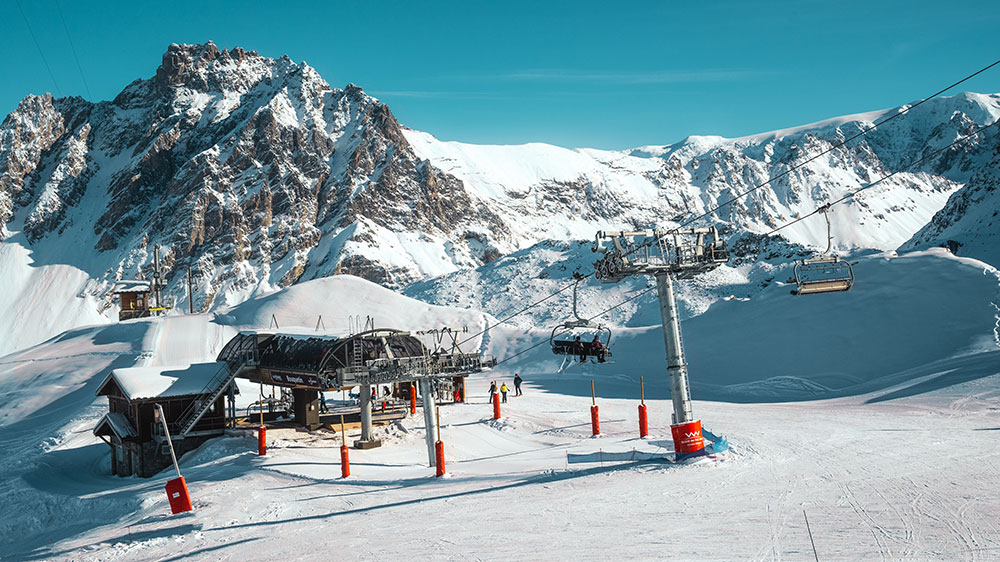
Since the 1990s, the Three Valleys have reduced the number of ski lifts from 200 to 161, a decrease of 39 installations while maintaining an equivalent skiable area. This has been achieved by replacing several older drag lifts and fixed-grip chairlifts with a single higher-capacity lift. The result is dozens fewer lift towers, fewer cables crossing the landscape, dismantled stations, and a significant reduction in visual impact.
The real cost of carbon: the true weight of a ski lift
Building a new ski lift is not carbon neutral, it involves several hundred tonnes of CO₂ equivalent (tCO₂e) depending on the size. That’s why our strategy can’t be to replace one ski lift with another, but rather:
- to remove without replacing when circumstances permit (examples: Creux Noirs, Glacier, Ramées and Montagnette chair lifts and the Montaulever drag lift).
- to consolidate multiple existing lifts into one higher-capacity lift. Such was the case with the Combes Moriond chair lift and the Pointe de la Masse gondola lift, each of which replaced 4 existing lifts.
- to reuse dismantled components sourced from other resorts, as we did with the 2 Lacs chair lift, which was repurposed to build the Roches Blanches lift in Val Cenis.
- refurbishing key lift installations significantly reduces greenhouse gas emissions compared with building entirely new infrastructure. This approach was adopted for the Olympe Gondola, which underwent a mechanical refurbishment in 2021 followed by the redevelopment of its lower station in Brides-les-Bains in 2025, as well as for the Rhodos Gondola.
Since the enactment of the Mountain Law II (2016), all newly authorized ski lifts have been subject to a mandatory dismantling and site restoration requirement at the end of their operational life. These works must be carried out within three years of the lift's permanent closure.
The industry has since developed dedicated recycling channels, particularly for the galvanized steel used in lift towers. While the reuse of equipment between ski resorts remains less common, it is progressively becoming more structured.
Furthermore, the complete removal of concrete foundations involves extensive works and generates a significant carbon footprint. In many cases, leaving these structures in place, some of which have been part of the landscape for several decades, represents a more environmentally responsible solution. When their presence does not create any significant visual or ecological impact, we therefore favor their preservation while restoring and renaturalizing the surrounding areas.