

The black grouse, a fragile species at the heart of our ski areas
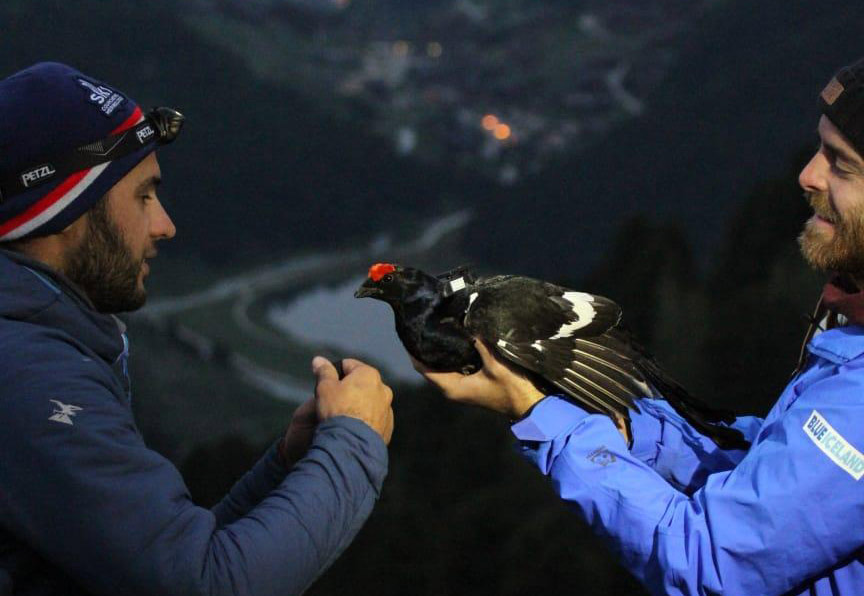
The little wood grouse is a heritage species, a sentinel watching over the Alps. It is disturbed by human activity, which is why we are taking steps to protect it.
An emblematic and fragile species
The black grouse is an emblematic landfowl in Alpine areas. It lives in very specific habitats, at the border between subalpine forests and high-altitude open land (typically at altitudes between 1,500 – 2,300 metres), which makes it a heritage species: it is only found in the mountains, and certain Alpine populations are strictly endemic to the area.
Currently, its global conservation status is Least Concern, with a population estimated between 16,000 – 20,000 in the French Alps.
The black grouse faces three major threats, all of which can be found in our ski areas
Winter Disturbance
In winter, to survive the cold and the scarcity of food, the black grouse spends around 20 hours a day motionless, either in a snow burrow it has dug for itself or perched on a low conifer branch. It feeds for only about four hours each day. Every forced flight triggered by a skier, hiker or dog consumes a significant portion of its energy reserves.
Collisions with cables
Ski lift cables are almost invisible to birds in flight. The European POIA BirdSki programme, to which our data contributed, has shown that black grouse perceive contrasts less effectively than humans and that their vision is particularly impaired during poor weather conditions.
Habitat Fragmentation and Loss
Ski slopes, earthworks, infrastructure development and climate change all contribute to reducing and fragmenting the black grouse's habitat. Breeding areas, including lekking sites in spring and nesting areas in summer, must remain connected to wintering grounds in order for populations to remain viable.
Les 3 Vallées has been committed to a landfowl monitoring agreement with the French Biodiversity Agency (OFB) and the Vanoise National Park (PNV) for several years now and has since been joined by local municipalities.
Concrete steps taken:
170 INDIVIDUALS
Equipped with GPS transmitters to track their movements, accurately identify their core habitats and assess the use of specially created refuge areas.
2024
Launch of a PhD research programme to scientifically analyse these data and better understand how ski areas overlap with black grouse habitats.
2022
Extension of the study to other species: the rock partridge, alpine ptarmigan and golden eagle.
POIA BirdSki is a collaborative programme bringing together the Vanoise National Park, Asters - Haute-Savoie Natural Areas Conservancy and the Mountain Grouse Observatory, among others. It builds on several years of scientific monitoring carried out across the Three Valleys to better understand the interactions between winter recreational activities, mountain infrastructure and Alpine bird species.
The programme aims to turn the scientific knowledge gathered within ski areas into practical recommendations that can be applied throughout the Alps, including the design of bird markers, the location of wildlife refuge areas and best-practice guidelines for mountain development projects.
Based on this knowledge, dedicated wildlife refuge areas have been established on the ground:
Courchevel
Since 2013, a network of five wildlife refuge areas covering nearly 40 hectares has been created close to the ski slopes.
Les Menuires
In 2024, a 7.5-hectare refuge area was established in the Masse sector. SEVABEL is also installing bird markers on all technically suitable cables, with the objective of achieving full coverage by 2028.
Val Thorens
SETAM is installing bird markers on cables identified as posing a collision risk to birdlife. Five devices have already been installed, and the programme is continuing in order to improve cable visibility for the most sensitive mountain species.
Wildlife refuge areas are marked by deliberately low-impact installations such as wooden posts, ropes and information signs. Their purpose is not to restrict access to the ski area, but to make skiers and hikers aware that they are entering a sensitive wildlife habitat. The effectiveness of these areas relies primarily on awareness, education and respect for the signage. In addition, tree planting programmes carried out in partnership with the French National Forest Office (ONF) gradually improve habitat quality and, over time, make these areas naturally less accessible.
A bird mark (or bird flight diverter) is a visual device attached to aerial cables to make them more visible to birds and reduce the risk of collisions. Within the framework of the AVIFAUNA Agreement in the Three Valleys, the objective is not only to install bird marks, but also to determine which designs are the most effective, how far apart they should be placed and which cables should be prioritised, based on the scientific data collected.